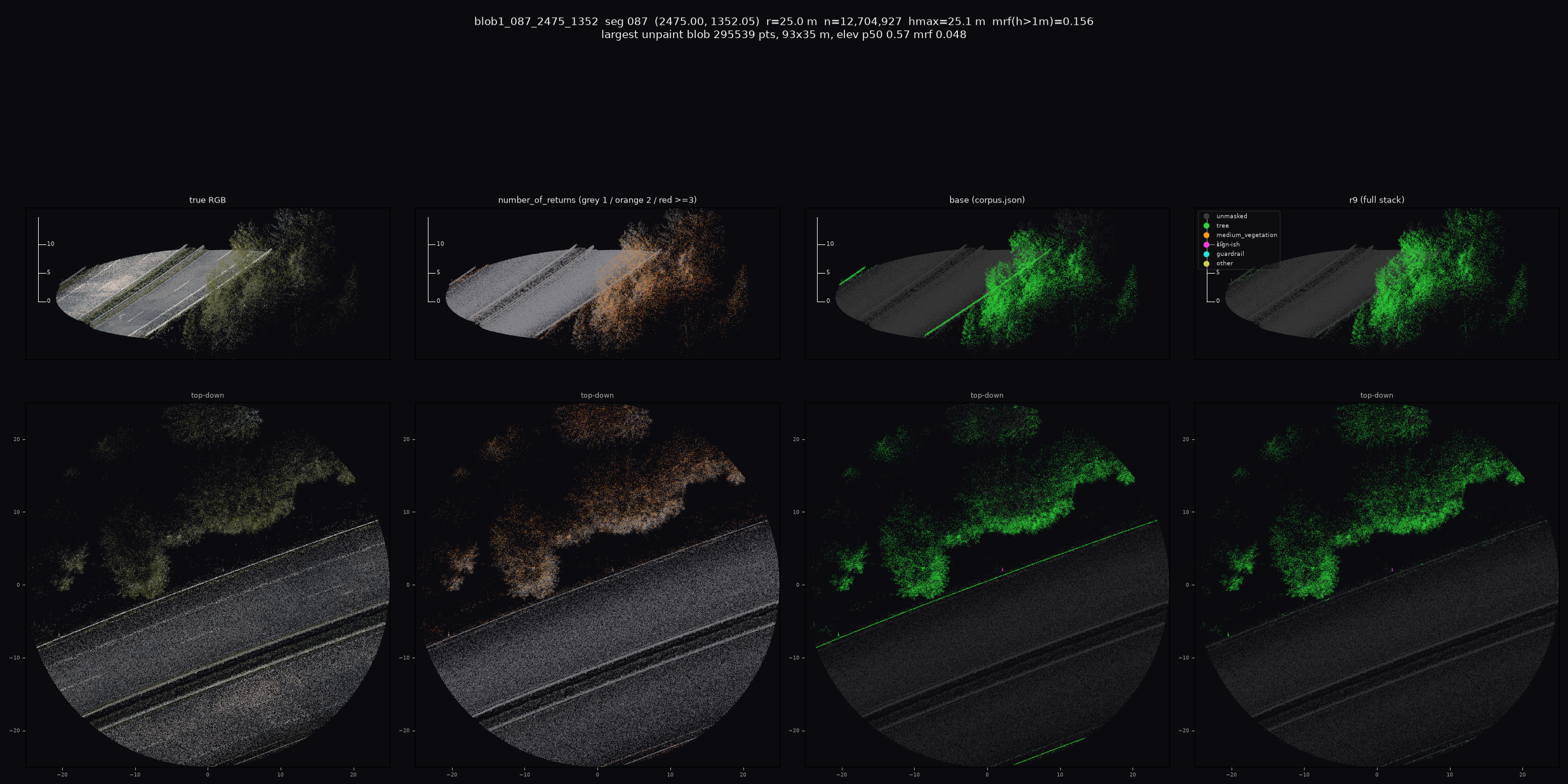
A. The recall win: paint the canopy above the 10 m slab >10 m recall 0.018 → 0.769
mrf ≥ 0.20 + mr3 ≥ 0.02 the crowns are painted to their tops.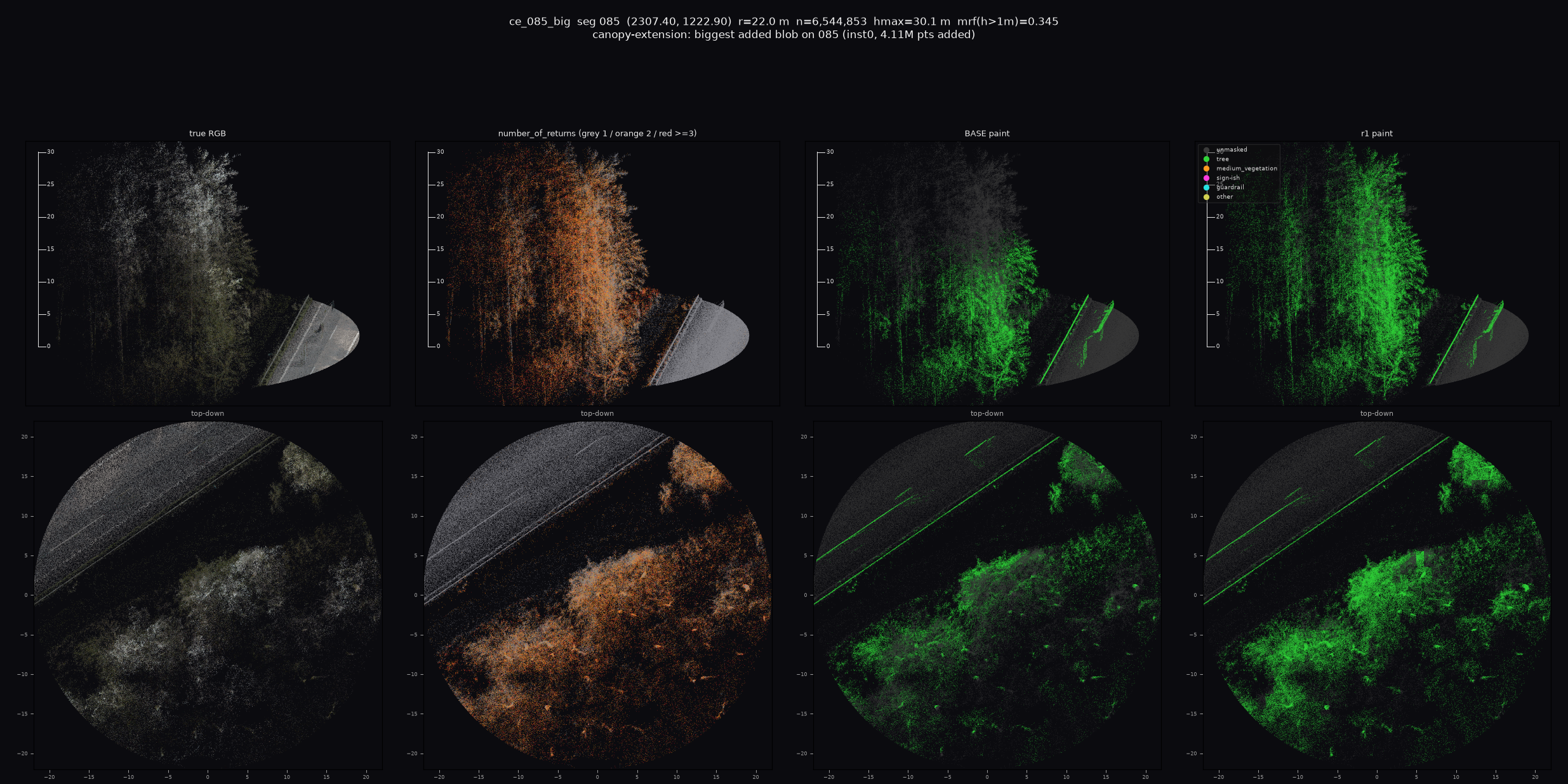
number_of_returns to fix tree recall and foliage-vs-structure — final summarynumber_of_returns
(multi-return = foliage). Use it to (1) improve tree recall — the v6 hedge gate and the 10 m
candidate slab were tuned on scan-angle-filtered data that cut tree tops and trunks off — and (2)
separate foliage from signs, guardrails and walls.Segments 003 / 022 / 023 / 087 / 093 / 094. base = cfg/corpus.json
(every new knob OFF) vs r9 = cfg/r9.json (the shipped stack). 12 detector runs,
all rc = 0, zero errors, mask_file_missing = 0 everywhere. Source:
eval/val_judgement.md.
| metric | base | r9 | delta | read |
|---|---|---|---|---|
| M1 canopy recall > 10 m (2.37 M pts) | 0.0175 | 0.7693 | +0.752 | the upper canopy was simply not painted before |
| M1b canopy recall 4–10 m (7.84 M pts) | 0.7503 | 0.9031 | +0.153 | positive on 6/6 segments |
| M2 foliage-cell recall, segment-wide (14 449 cells) | 0.4942 | 0.8601 | +0.366 | unmasked remainder 16.1 M → 4.5 M pts |
| M3 hard-contamination cells | 111 | 26 | −85 | down on 6/6 |
| M3 hard points inside tree paint | 137 009 | 34 057 | −75 % | hard fraction 0.00363 → 0.00068 |
| M6 truth-spot recall (48 tree spots) | 1.000 | 1.000 | 0 | both not_tree spots bit-identical |
| M4 signs | 4 | 5 | +1 real | 0 removed; rendered and confirmed |
| M4 delineators | 88 | 88 | 0 | rail half-post CSVs md5-identical on 6/6 |
| M4 tree detections | 331 | 322 | −9 | all 9 rendered: road / mast / barrier slivers, 0 vegetation |
| M5 runtime, worst segment | 308 s | 447 s = 7.4 min | +45 % | 37 % of the 20 min/segment budget |
| old-data parity, packaged defaults | identical | — | clusters.csv, tree_clusters.csv, point_masks.npz row-for-row and bit-for-bit; one crown-circle float inside the P2 overlay tolerance | |
| cluster-verdict churn (sign path) | 22 / 3 964 = 0.55 % | — | the pass-2 blocking instability was 7.6 % | |
1 872 942 annotator-labelled points, 100.000 % matched within 5 cm. “Veg-tolerant precision”
counts annotator classes 74 (low veg) and 75 (medium veg) as acceptable, because whether attached
shrubs count as tree is exactly open item 1. Source: eval/r9_judgement.md.
| metric | base | r6pr (pass 7) | r8 (pass 8) | r9 |
|---|---|---|---|---|
| precision | 0.489 | 0.4884 | 0.5028 | 0.5431 |
| veg-tolerant precision | 0.741 | 0.7490 | 0.7705 | 0.8528 |
| recall (GT tree, class 5) | 0.755 | 0.7547 | 0.7547 | 0.7547 |
| hard FP (guardrail + road + barrier) | — | 52 300 | 46 519 | 26 965 |
| GT guardrail points painted tree | — | — | 25 772 | 6 276 |
Recall did not move by a single point across nine passes — every gain in precision was paid for with zero true-tree loss. The remaining 085 error is 19 892 road + 6 276 rail that the seg3d guardrail model itself misses, both inside the two mega-instances that also hold every true positive.
| knob | what it does | evidence |
|---|---|---|
canopy extensioncanopy_extension_enabled, min_multi_return_fraction 0.20, min_triple_return_fraction 0.02 | Above the 10 m candidate slab, paint each 1 m column cell whose points are multi-return foliage and continue upward. This is the whole recall win: the old slab simply stopped at 10 m. | pass 2–3 — truth-spot recall > 10 m 0.019 → 0.879 on the training segments; +0.752 on val; +1.7 % runtime |
returns stripper on the sign pathreturns_stripper.enabled, tau 0.30, radius 0.75, reject_promoted_poles (+ min_fraction 0.03) | Drop multi-return (foliage) points from sign candidates before the shape features, so a plate buried in a crown is still recognisable. Guards: min cluster height 1.5 m, min 20 dropped, keep-only sparse fallback, min remaining 0.5, max surviving mrf 0.25, neighbour rules computed on unstripped geometry, and a guard that rejects poles promoted purely by stripping. | pass 2–3 +2 real signs on 018; pass 5 pole guard; val: +1 real sign, 0 lost, churn 0.55 % |
sparse-sign guardsign_post.min_points_per_m = 100 | Reject airborne “ghost” signs with no post: reason sparse_sign. | pass 2–3 — both 018 ghosts gone; real signs run 1 014–2 951 pts/m, ghosts 45–51 → 20× margin |
hard-blob unpainthard_blob_unpaint_enabled | After painting, find 1 m cells inside a tree instance with ≥ 300 pts and multi-return fraction < 0.05 — hard flat structure — and remove the paint there. | pass 2–3 — M3 hard cells 44 → 23, points −79 %; removed a billboard, lane markings, sign boards, road streaks |
… + instance rejecthard_blob_reject_instance_enabled | If a tree instance is mostly hard blob, drop the whole detection (hard_structure_returns). | pass 4 — 4 rejected, all structure; val: 9 rejected, 9/9 road / mast / barrier |
… + survivor testreject_max_survivor_mrf 0.1, reject_min_survivor_points 2000 | Only reject when what survives the unpaint is small and structure-like, so a real tree with a hard blob in it keeps its detection. | pass 6 — byte-neutral on the corpus (a safety rail, not a win); val: all 9 rejects tripped it correctly |
… + cell hysteresishard_blob_cell_hysteresis = 0.5 | 8-connected relaxation: a cell at 0.5× the point floor joins an existing hard blob, so a blob is not fragmented by its own sparse edge. | pass 7 — monotone, +5.4 k structure points unpainted, no crown touched |
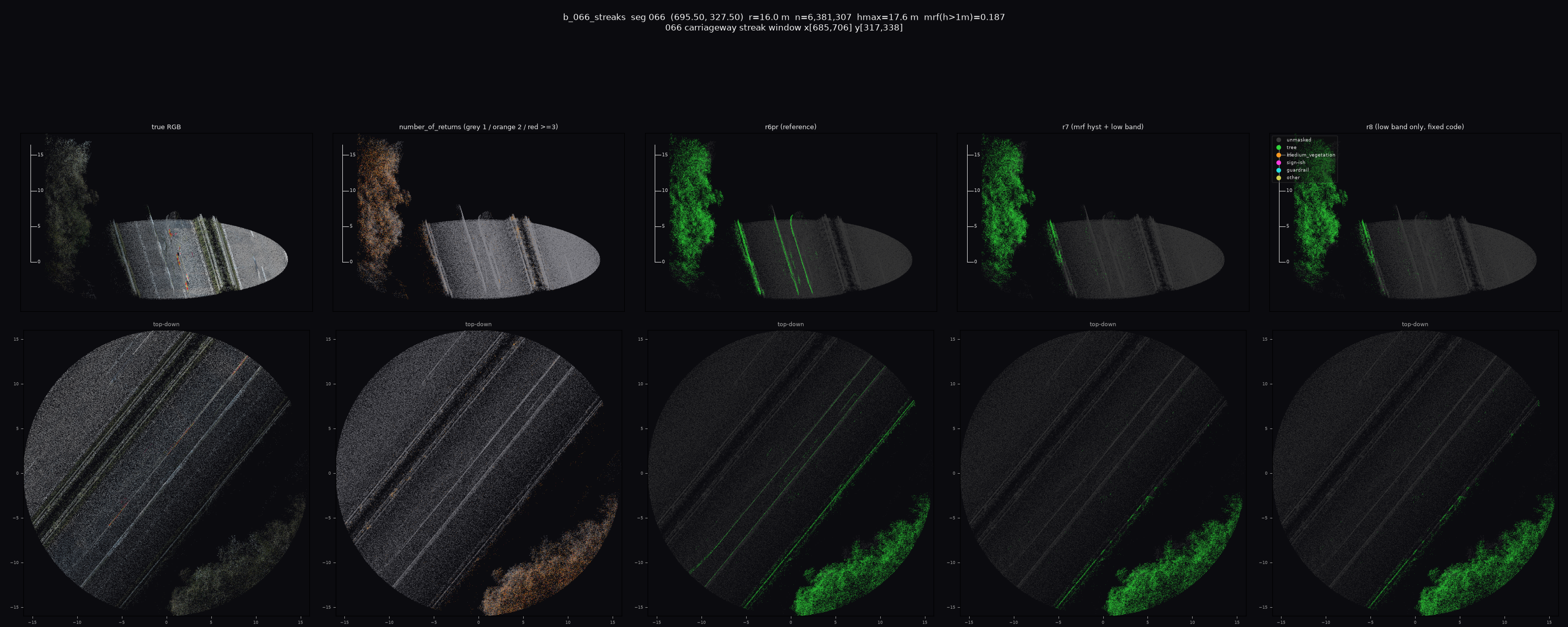
… + low band 0.3 m with canopy-column guardlow_band_min_elev_m 0.3, canopy_column_min_points 50, canopy_column_min_mrf 0.20 | Extend the hard-blob test down into the 0.3–1 m skirt, except under a column that has real canopy above it (so trunk bases and understorey survive). | pass 8 / pass 9 — 066 moving-vehicle streaks below 1 m −81 %, crowns bit-identical, 085 hard FP 52.3 k → 46.5 k, 0 GT-tree lost |
guardrail-mask unpaintguardrail_mask_unpaint_enabled, classes = [] (all), masks from rail_halfpost.models_dir | Remove tree paint from points that the seg3d guardrail model already claims. Point-level, so it reaches rails buried inside a mega-instance that no per-cluster rule can touch. Defaults OFF; a run without masks is unaffected. | pass 9 — 085 GT guardrail paint −75.7 %, hard FP −42 %, veg-tolerant precision 0.771 → 0.853, 0 GT-tree lost, 0 detections changed |
| performance lazy overlay fits, voxel-weighted lobe DBSCAN, convex-hull MEC prefilter | crown_circles() was 86 % of runtime and was computed for every cluster though only emitted detections consume it. Now fitted lazily at the two emission sites. | segment 002 1 355 s → 198 s (6.8×); decisions and masks bit-identical, only the crown overlay circles move |
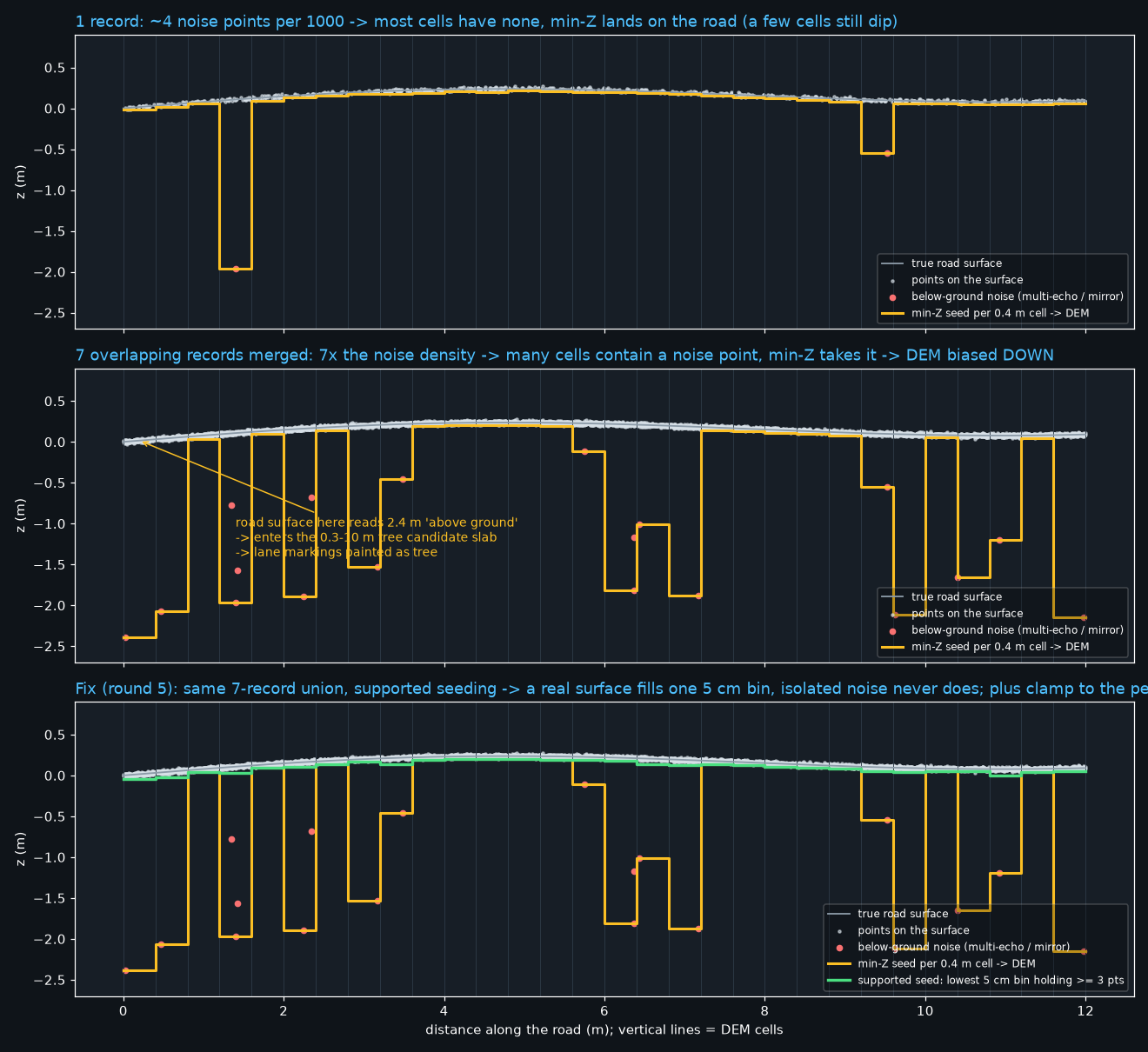
per-record TCS groundtcs_ground.per_segment = false (code path kept, off) | The per-segment ground union is implemented, reviewed and tested — supported seeding, record clamp, ELM rejection — but it never reached per-record parity, so the shipped default stays per-record. | pass 4 – pass 7; handed to tablecloth: segment-ground handoff |
Every one of these was implemented, run on ≤ 3 segments, measured, looked at, and deleted or defaulted off. That is the loop working.
| idea | verdict | why |
|---|---|---|
hedge-gate returns veto (max_multi/triple_return_fraction) | code removed | Fired on nothing: 0 gate-evaluated parents vetoed corpus-wide, 0 hedge verdicts overruled. The tree/hedge separation it needs does not exist in the returns signal (AUC 0.70). |
| returns stripper on the rail half-post path | code removed | Inert: the emitted half-post set was identical with and without it on all four segments. At tau 0.30 the emitted crest band loses ~100 % of its points and min_remaining_fraction restores it whole — a KD-tree per band cluster bought zero output change. |
| hard-blob mrf hysteresis 0.02 | default 0.0, code kept | All cost: it punched two axis-aligned 5-cell rectangles out of a continuous green shrub bank on 018 (26 127 points, greener than the paint retained a metre away) and never once fired on the 060 billboard it was written for. |
| per-segment TCS, naive min-Z seeding | reverted | Below-ground noise density scales with the number of drive passes; the union DEM sank to −8 m, road entered the candidate slab, and a real 018 sign was lost on a 27 mm shift. |
| per-segment TCS, supported seeding (lowest 5 cm bin with ≥ 3 pts) | reverted | Fixes every catastrophe but buys ~nothing (GT recall +0.001 — the earlier “win” was ground leakage) for +9–22 % runtime, and still misses 2 of 7 canaries. Per-cell support cannot separate isolated noise from sparse ground under a canopy. |
| per-segment TCS, ELM seed rejection | reverted | Made clamp-off worse: it empties 15 % of populated cells on the two worst segments and hands them to interpolation, because an 11×11 median on a road corridor sits on the verge or the barrier. |
| DEM percentile / cell size / noise trim changes | do not touch | Every alternative loses more true tree than hard FP. Least-bad (cell_m 1.5) removes 3.0 k hard FP for 4.4 k GT-tree points (ratio 0.68); a noise trim loses 135 k of 156 k GT-tree points. Keep percentile p8 / 0.75 m. |
| lower hard-cell point floor 300 → 100 | do not lower | The residual rails live in dense mixed cells (n p50 = 206, mrf p50 = 0.73) — they fail the mrf test, not the point test. Would capture 2 630 points = 5.8 % of the residual. |
| elongation gate on joined hard cells (L ≥ 5 m & W ≤ 2 m) | do not add | New cells 8-join onto the wide mega-instance blobs, so the joined component is never elongated: 10 points captured on 085, 0 on 066. |
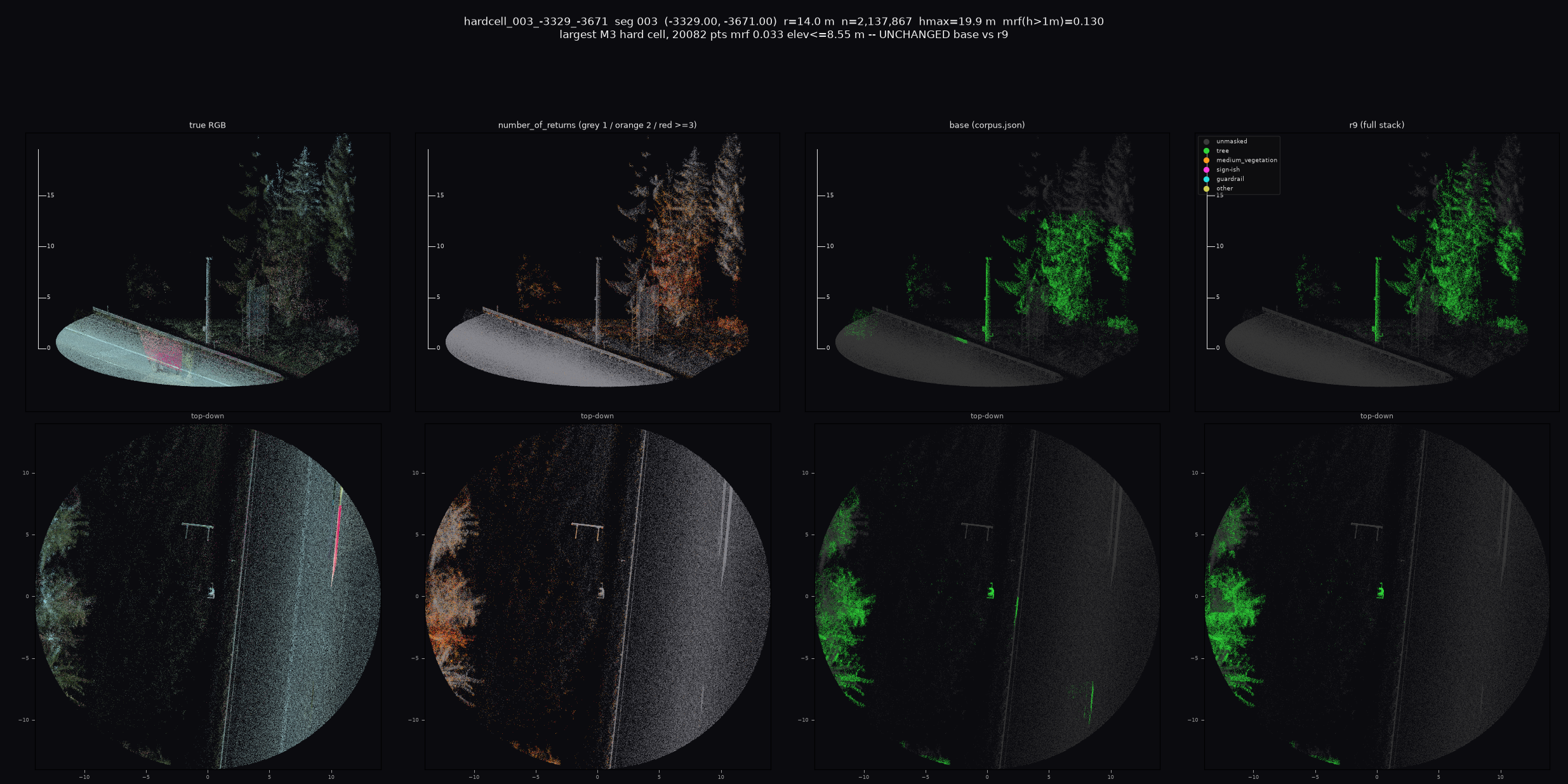
Panels are, left to right, true RGB | number_of_returns (grey = 1, orange = 2, red = ≥ 3) | BEFORE | AFTER; top row oblique, bottom row the same points top-down. The BEFORE column always comes first. Click any image for full resolution; ← / → (or swipe) step through the images of that card only; Esc closes.
unmaskedtreemedium_vegetationsign-ish (sign / pole / delineator)guardrailother
mrf ≥ 0.20 + mr3 ≥ 0.02 the crowns are painted to their tops.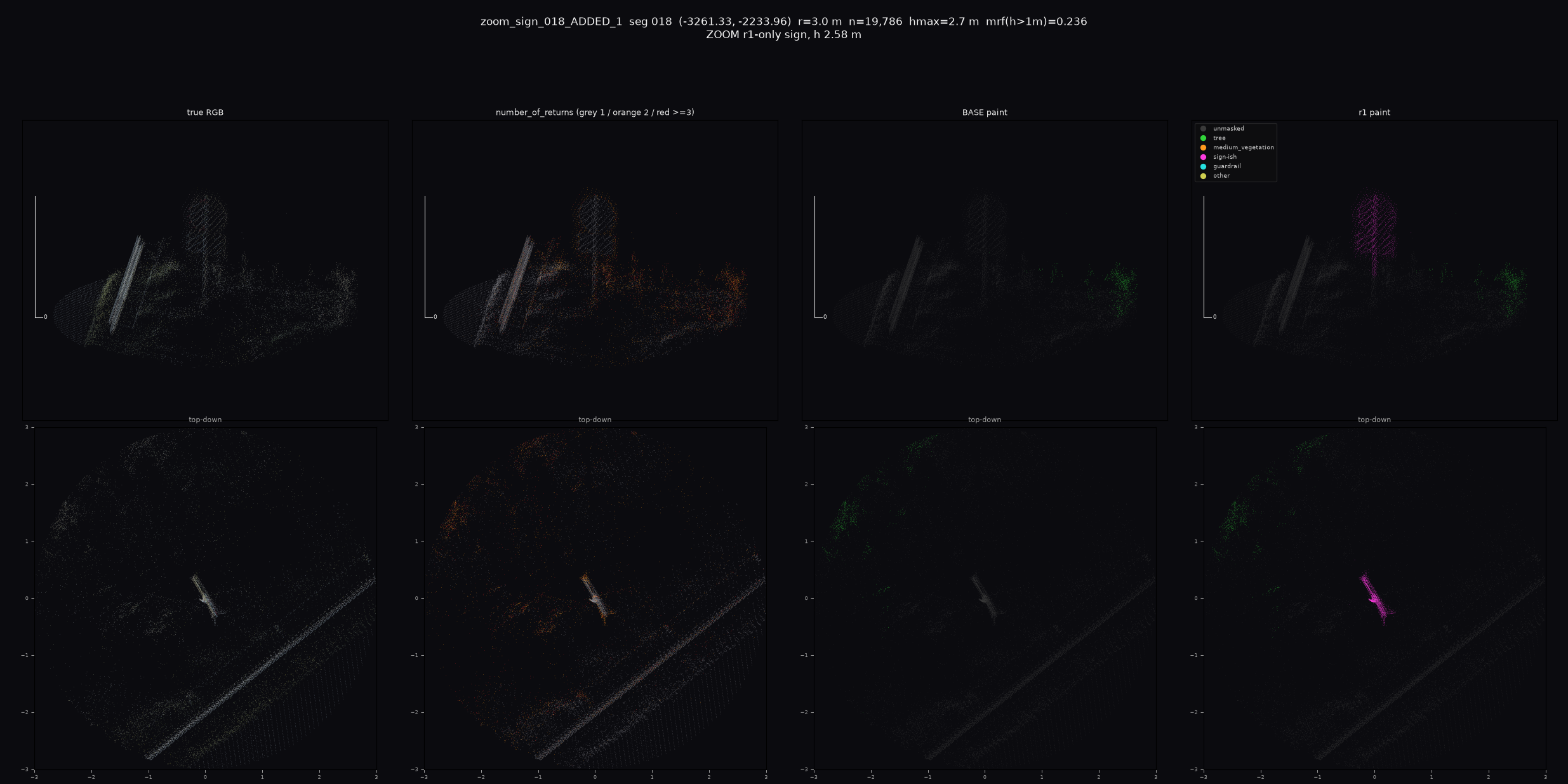
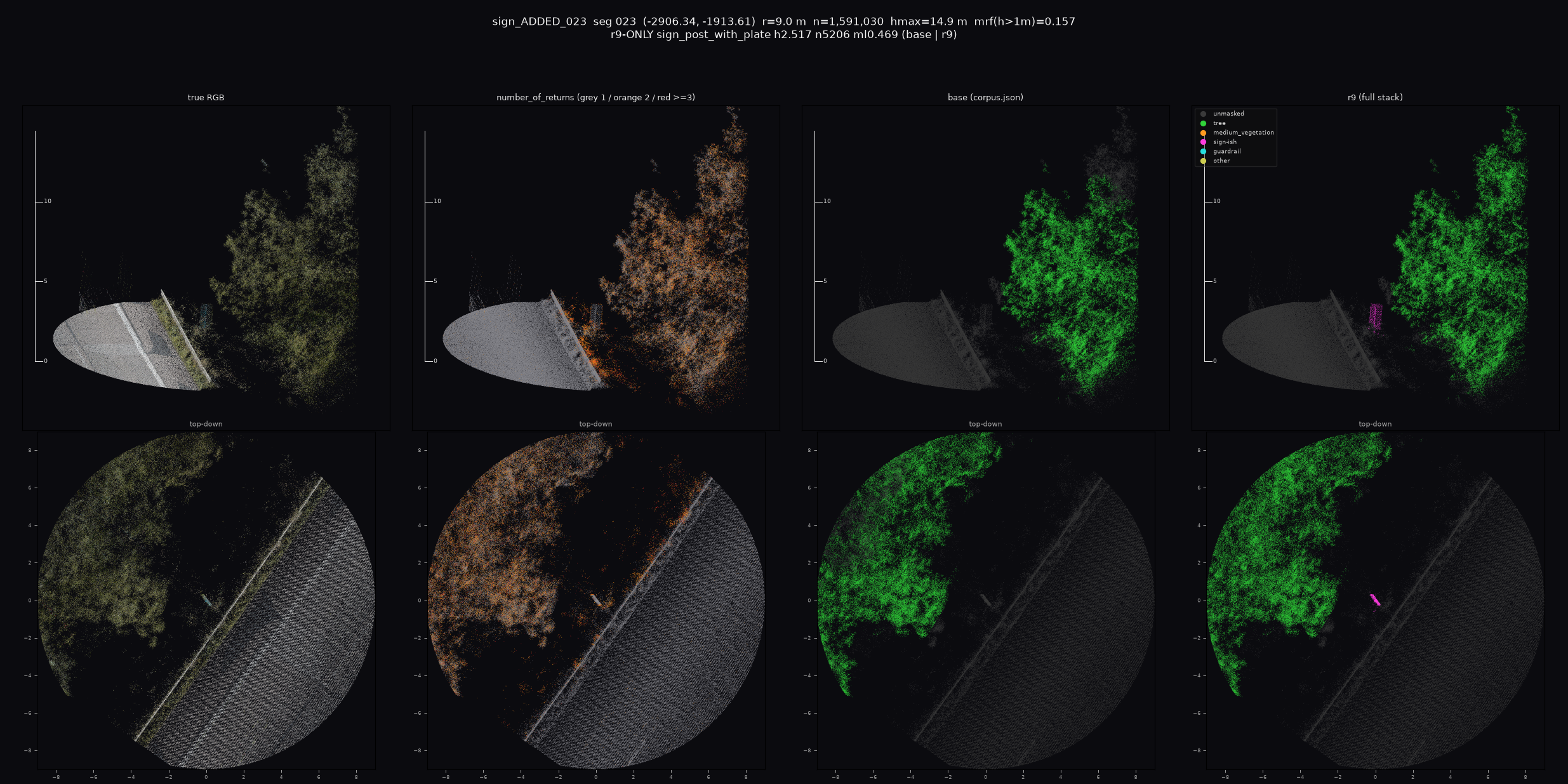
hard_blob_reject_instance: a thin all-single-return sliver on the median barrier in the middle of the roadway. All nine were rendered and judged: nine road-surface / mast / barrier artefacts, zero vegetation.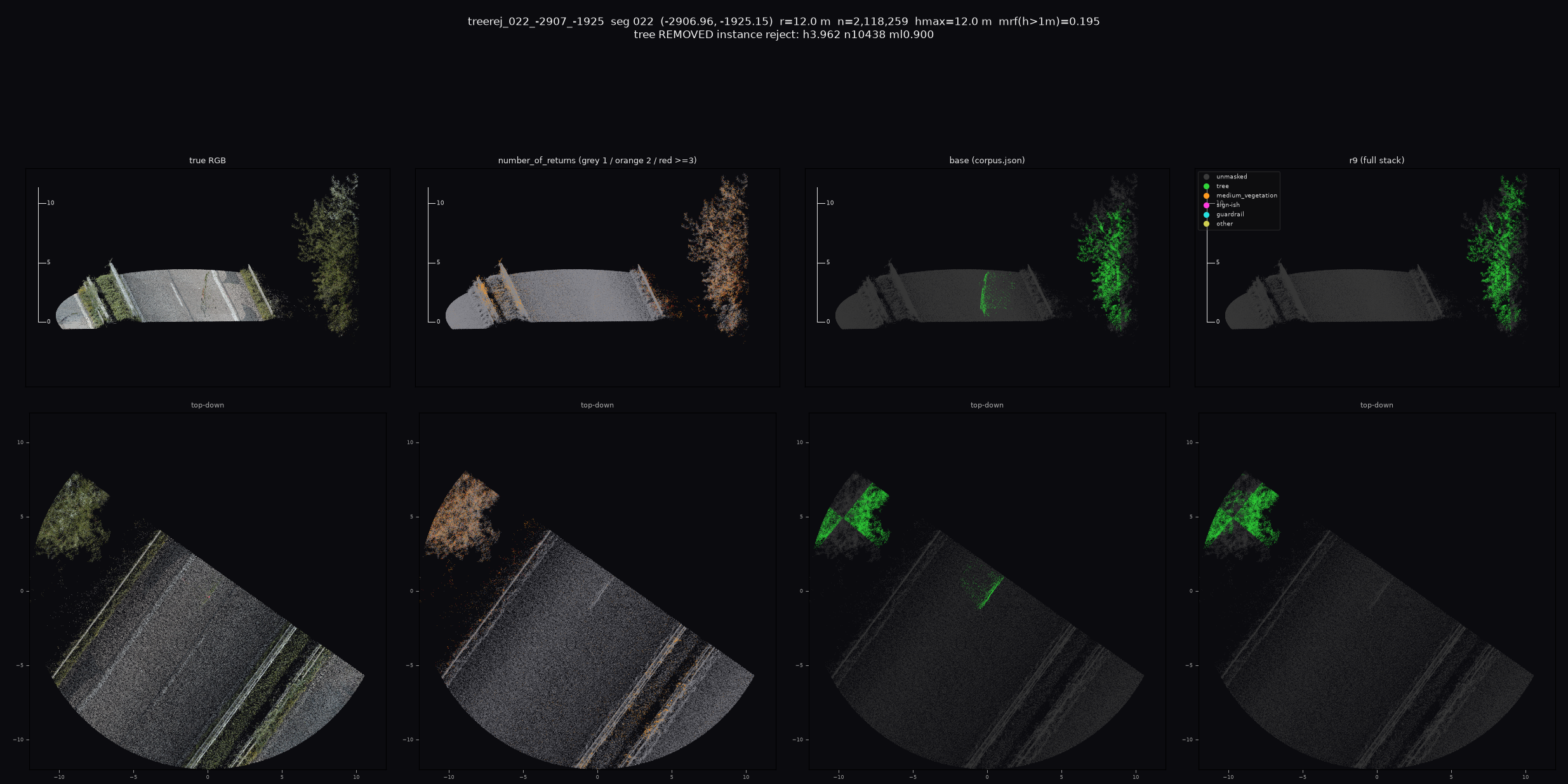
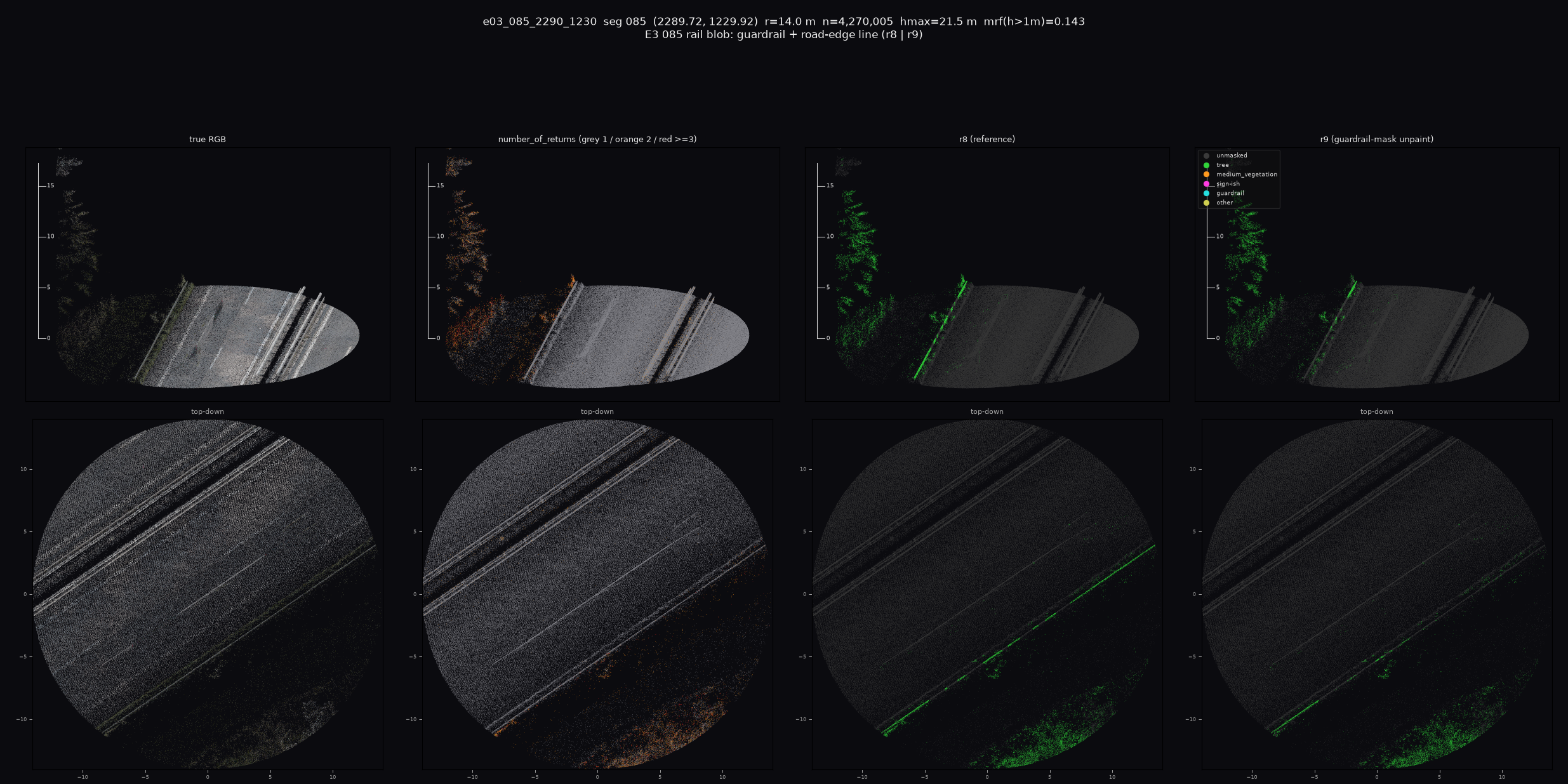
lowrej_018_c0_s0, 13.2 m — the cost check. r8 and r9 are indistinguishable: full crown, full understorey, only the guardrail line at the bottom edge lightly thinned. 0 GT-tree points lost on 085 (tp 156 209 in both roots).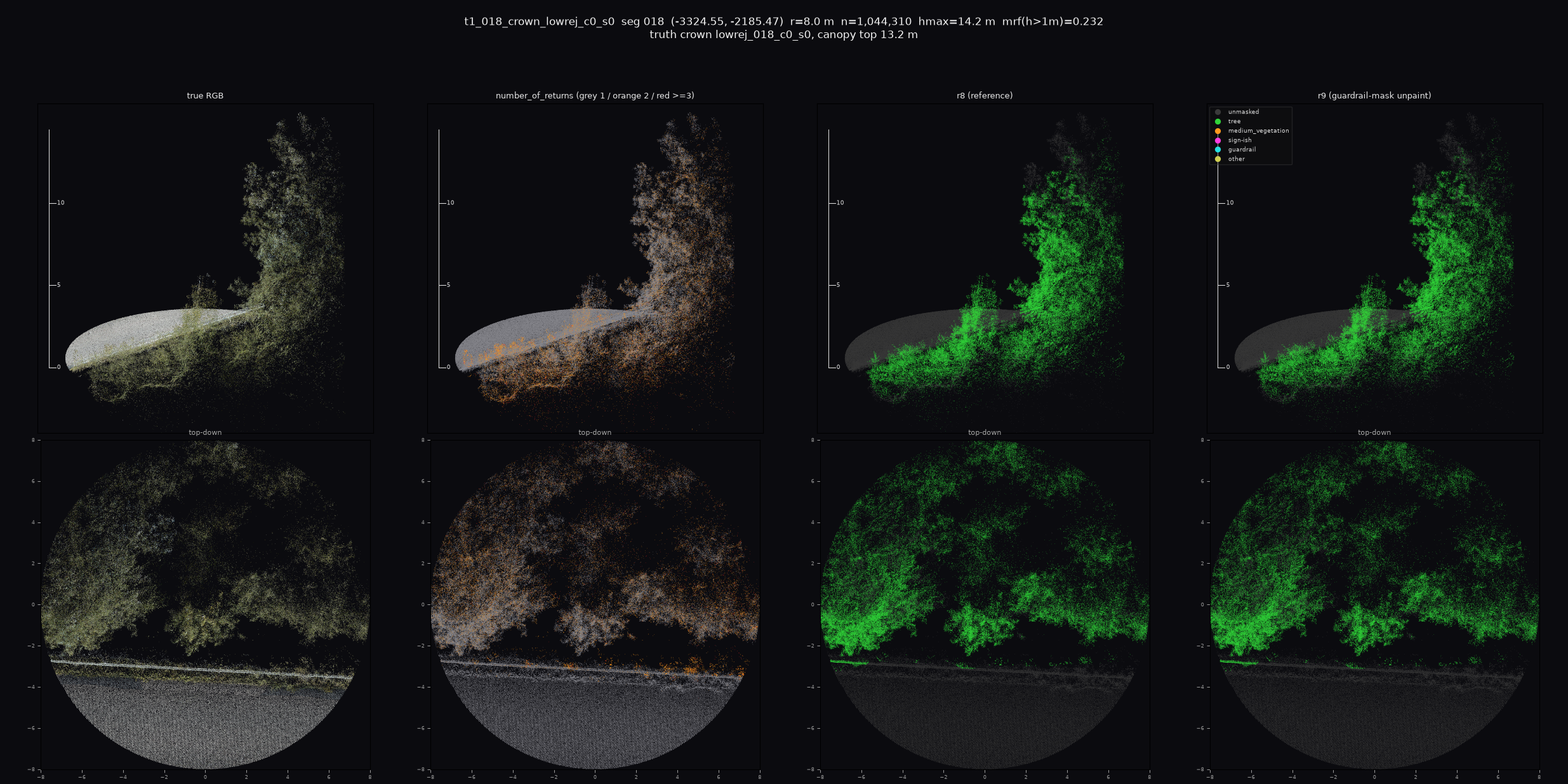
guardrail_mask_unpaint_classes = ["w_beam"] + mask erosion.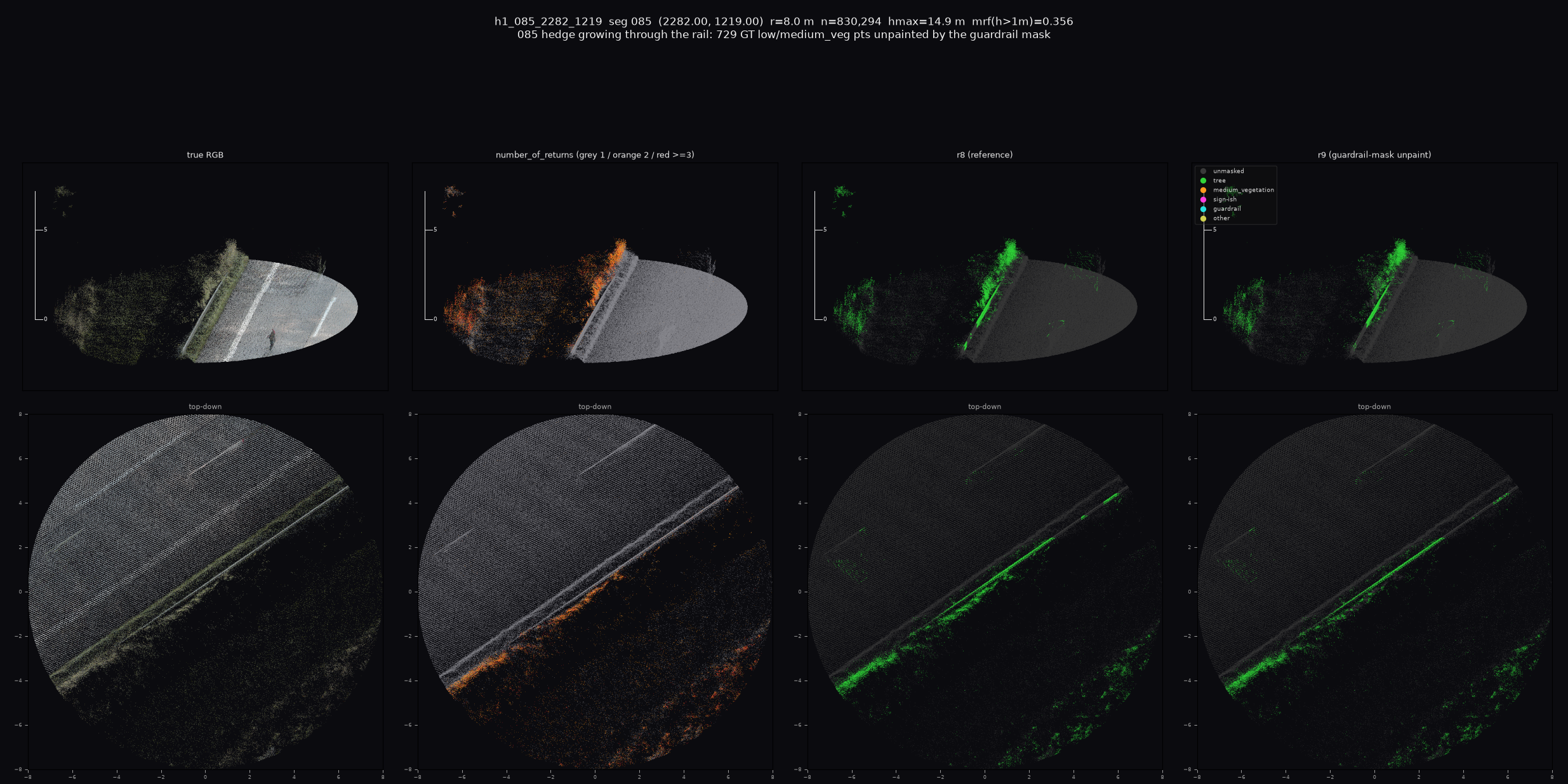
per_segment = false, handed the problem to tablecloth. Full explainer: DEM bias.
Stopping condition 2 was reached: what remains needs a human decision, annotation, or another team’s code.
| # | item | why it stops here |
|---|---|---|
| 1 | Do attached shrubs and grass under a tree count as “tree”? product definition | 67 % of the remaining false positives against the 085 human GT are annotator classes 74 (low veg) and 75 (medium veg) inside our tree paint. If they count, precision is 0.853, not 0.543. This is a definition, not a bug — nothing should be tuned until it is answered. |
| 2 | Mega-instance splitting seg3d | Single verge instances 78–100 m long swallow rails, road and vehicles along with every true positive (085 instance 3 = 6.9 M points and zero GT trees). No per-cluster rule can reach inside them; only a point-level mask or an instance split can. |
| 3 | Lamp / camera masts and gantry columns painted tree separate ticket | Vertical, single-return, tall — and a genuine column, so no unpaint knob distinguishes them from a trunk. Needs a pole-vs-trunk discriminator. Visible on 003 at (−3329, −3671), 20 082 points, identical in base and r9. |
| 4 | Tree vs hedge cannot be separated by returns needs labels | Measured AUC 0.70 — not a discriminator. Miro’s hedge definition is a size/band property, not a foliage property. Any progress needs labelled hedges, not more features. |
| 5 | return_number export available, not needed | Only number_of_returns is exported today; return_number exists in the LAS on N: and would allow first/last-echo logic. Nothing in this ticket needed it — do not spend the export effort speculatively. |
| 6 | Per-segment TCS ground handed over | Four passes of work, reviewed and tested, shipped OFF. Handed to the tablecloth repo with the seeding, clamp and noise-rejection findings: handoff-tablecloth-segment-ground-default-20260906-1420. |
| 7 | seg3d fuse: add tree to PAINT_FIRST_CLASSES one-line change | In 3dsegmentation/masks.py, guardrail classes are PAINT_LAST (they already override tree), but tree (LAS 5) has rank 0, so road and vehicle rows we paint tree still leak through the fuse. Low/medium vegetation are already PAINT_FIRST. |
| what | where |
|---|---|
| worktree / branch | /home/ai/dev/wt-vs-382, branch feat/AI3D-382-returns-recall (146 commits, not pushed — house rule) |
| recommended config | configs/a1nr_returns_recommended.json in the repo (documented in README.md); the run-shaped copy is cfg/r9.json in the scratch tree |
| tests | 1 811 — uv run pytest -q; lint uv tool run ruff check src tests scripts |
| scratch root | /home/ai/veg373_work/returns/ |
| configs | cfg/ — corpus.json (base) … r9.json (shipped), v6mv_nr.json (baseline) |
| detector outputs | out/ — r1…r9, val_base, val_r9, parity_final_old_002 |
| judgements | eval/r1_judgement.md … eval/r9_judgement.md, eval/val_judgement.md (the final gate) |
| renders | analysis/r1_renders/ … analysis/r9_renders/, analysis/val_renders/, analysis/dem_bias/ |
| diagnoses | diag/DIAG_treepaint.md (066 vehicles, 085 GT breakdown), diag2/DIAG_dem_hardcells.md (DEM alternatives, hard cells) |
| data | /home/ai/veg373_work/returns/data/A1NR/lane_points (14 truth segments, no scan-angle filter, with number_of_returns) |
| seg3d guardrail masks | /home/ai/seg3d_out/260905/guardrails_A1B0 → rail_halfpost.models_dir |
| run command | uv run verticalsigns-detect --data-dir <data> --segments 085 --out <out> --config cfg/r9.json --dump-point-masks --log-level INFO |